
Laundry is one of the most ordinary routines at home. Yet small choices can make a noticeable difference to how textiles feel, smell and age over time.
Laundry vinegar is a simple rinse aid used in place of conventional fabric softener. It helps soften laundry, neutralise unwanted odours and leaves textiles feeling fresh without a heavy fragrance.
But how exactly do you use laundry vinegar? Is it suitable for towels and sportswear? And are there situations when it is better not to use it?
Here is our practical guide.
What is laundry vinegar?

Laundry vinegar is a vinegar-based rinse aid designed for textile care.
Unlike laundry detergent, it is not responsible for actually washing dirt from your clothes. It is added during the rinse cycle, in the same compartment where you would normally add fabric softener.
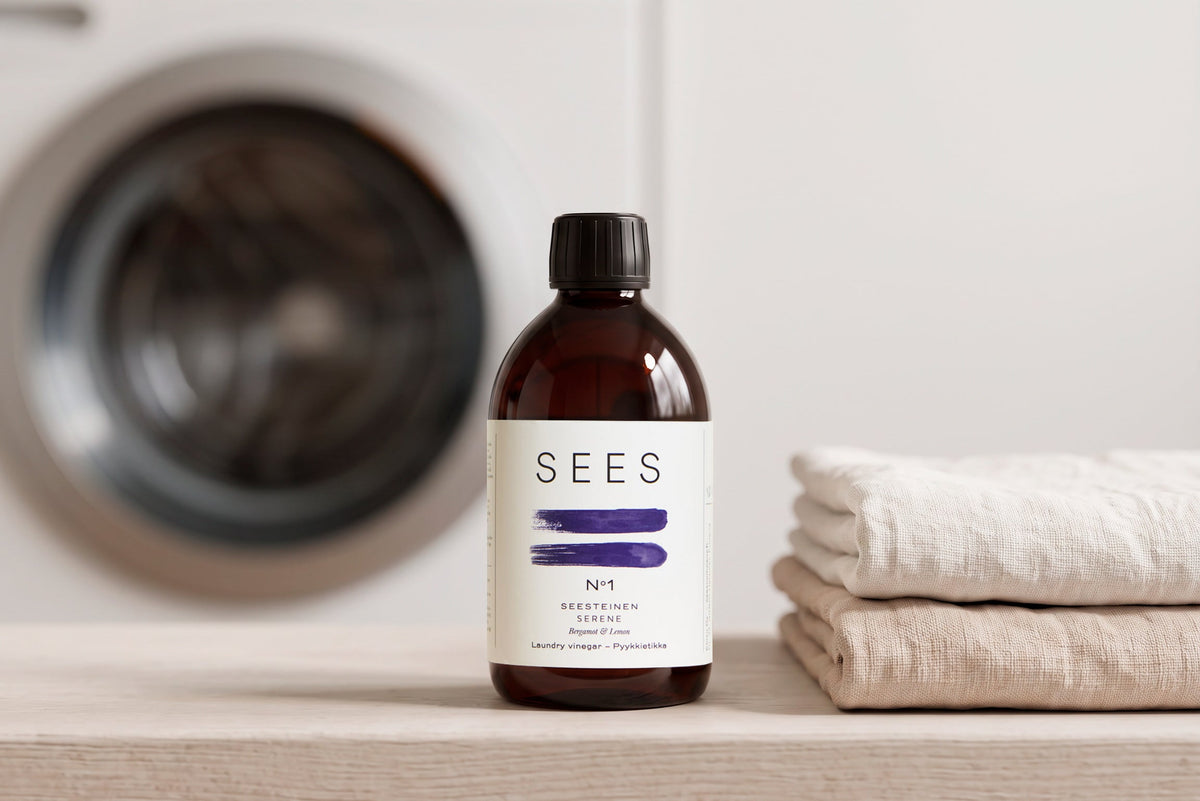
SEES Laundry Vinegar is made in Finland from spirit vinegar and scented with pure essential oils. Our Bergamot & Lemon Laundry Vinegar contains just three ingredients: spirit vinegar, bergamot essential oil and lemon essential oil.
It contains no artificial fragrances, colourants or preservatives, optical brighteners, chlorine or added water.
The result is a concentrated everyday product: only a small amount is needed for each wash.
What does laundry vinegar do?
1. It softens laundry
Laundry vinegar can be used instead of conventional fabric softener to leave textiles feeling naturally softer after washing.
This makes it particularly useful for everyday textiles such as clothes, bed linen and towels.
Traditional fabric softeners work by leaving conditioning ingredients on textile fibres. Laundry vinegar works differently and does not create the same type of softening coating.
For towels in particular, this can be useful when you want softness while maintaining their natural absorbency.
2. It helps neutralise unwanted odours
Some odours can remain in textiles even after washing – particularly in sportswear, towels and clothes that have been stored for a while.
Laundry vinegar helps neutralise these unwanted smells rather than simply covering them with a stronger fragrance.
This is also why the product itself can smell surprisingly strong when you open the bottle. Once diluted in the rinse water and the laundry has dried, the characteristic vinegar scent disappears.
What remains is a much more delicate scent from the essential oils.
3. It gives laundry a subtle scent
Laundry does not always need to smell strongly perfumed to feel fresh.
SEES Laundry Vinegar, Bergamot & Lemon is scented only with essential oils. Lemon gives the fragrance its bright citrus character, while bergamot adds a softer, green and slightly more complex note.
The scent is designed to remain subtle on dry textiles – more of a finishing touch than a perfume.
4. It can help with stubborn odours
For sportswear and textiles with persistent smells, laundry vinegar can also be used as a diluted pre-soak before washing.
This gives the vinegar more time to work before the normal wash cycle begins.
How to use laundry vinegar in the washing machine
Using laundry vinegar is simple.
Shake the bottle before use and pour 2–3 capfuls into the fabric softener compartment of your washing machine.
Add your normal laundry detergent to its usual detergent compartment and select the appropriate washing programme for your textiles.

Laundry vinegar and detergent have different jobs and enter the wash at different stages: the detergent cleans during the main wash, while the laundry vinegar is released later during rinsing.
There is no need to add conventional fabric softener as well.
Always follow the care instructions of your textiles and the instructions provided by the manufacturer of your washing machine.
How to use laundry vinegar for sportswear and stubborn odours
For a more intensive treatment, SEES Laundry Vinegar can be used as a pre-soak.

Mix 100 ml laundry vinegar with 5 litres of water.
Soak the textile for 15–30 minutes.
Gently squeeze out the excess water without rinsing and then wash the textile in the washing machine as usual.
As with all textile care, check the garment's care label before soaking, particularly with delicate or specialist materials.
Does laundry smell like vinegar afterwards?
No – once used correctly and allowed to dry, your laundry should not smell like vinegar.
The vinegar scent is most noticeable when you smell the concentrated product directly from the bottle. During washing it is heavily diluted, and the volatile vinegar aroma dissipates as the textile dries.
With scented laundry vinegar, a delicate fragrance from the essential oils remains.
This difference is worth keeping in mind when trying laundry vinegar for the first time: do not judge the final scent by smelling the bottle.
When should you not use laundry vinegar?
Laundry vinegar is easy to use, but there are a few important exceptions.
Do not mix laundry vinegar with chlorine bleach
Never mix vinegar with chlorine bleach or products containing chlorine. Combining an acid such as vinegar with chlorine bleach can release dangerous chlorine gas.
If you use bleach or another specialist laundry treatment, always follow the manufacturer's instructions carefully.
Do not pour concentrated laundry vinegar directly onto textiles
Use the fabric softener compartment for a normal machine wash.
For pre-soaking, always dilute the laundry vinegar according to the instructions rather than applying the concentrated product directly to the fabric.
Check your washing machine instructions
Washing-machine manufacturers have different recommendations regarding vinegar-based products. Some explicitly advise against using vinegar because repeated exposure to acid may affect certain rubber components and seals.
For this reason, always follow the instructions for your particular washing machine. Laundry vinegar should not automatically be treated as a washing-machine cleaner or descaler, and more is not better.
If your machine has an automatic detergent or fabric-softener dosing system, check the manufacturer's instructions before adding a vinegar-based product to the reservoir.
Follow the textile care label
Specialist and delicate textiles can have their own care requirements.
When in doubt, follow the garment manufacturer's instructions. This is particularly important for technical materials and garments with special coatings or finishes.
Laundry vinegar or fabric softener?
Both products are added during the rinse cycle, but they are not the same thing.
A conventional fabric softener uses conditioning ingredients to change the feel of textile fibres and often adds fragrance at the same time.
Laundry vinegar is a simpler vinegar-based rinse aid. It is particularly useful when you want to soften and freshen laundry without the coating associated with conventional fabric softeners.
For many households, the choice comes down to what they want from their laundry routine: a more traditionally conditioned feel and fragrance, or a simpler rinse with a lighter scent.
A Finnish take on an everyday essential
At SEES, we are interested in the small details that make everyday routines feel considered.
Our Laundry Vinegar, Bergamot & Lemon is made in Finland from spirit vinegar and pure essential oils. The fresh citrus scent combines bright lemon with green, refined bergamot – a subtle fragrance designed to become part of the home rather than dominate it.
The product is vegan and carries the Key Flag, Design from Finland and Vegan trademarks.
Sometimes wellbeing at home is not about adding more. It can simply mean choosing everyday essentials carefully – and enjoying the small rituals that come with using them.
Laundry vinegar: the essentials
Where do I put laundry vinegar?
In the fabric softener compartment of the washing machine.
How much should I use?
For SEES Laundry Vinegar, use 2–3 capfuls per normal wash.
Do I use detergent as well?
Yes. Use your normal laundry detergent in its own compartment. Laundry vinegar replaces fabric softener, not detergent.
Can I use laundry vinegar for sportswear?
SEES Laundry Vinegar can be used as a diluted pre-soak for stubborn odours: mix 100 ml with 5 litres of water, soak for 15–30 minutes and then wash normally. Always follow the garment's care instructions.
Will my clothes smell like vinegar?
The vinegar scent dissipates as the laundry dries, leaving the more delicate scent of the essential oils.
Can I use laundry vinegar to clean my washing machine?
Laundry vinegar is designed as a textile rinse aid, not as a substitute for a washing-machine cleaning or descaling product. Follow the cleaning instructions provided by your appliance manufacturer.
Discover a fresher laundry ritual
A simple rinse can make a familiar everyday routine feel a little more considered.
Discover SEES Laundry Vinegar, Bergamot & Lemon
See also: Laundry detergents & vinegars · Textile sprays · Home care